Calling Hours Across Time Zones: Where Your Dialer’s Schedule Becomes a Compliance Risk
A calling schedule can look reasonable at headquarters and still place calls outside the permitted window for the people you’re trying to reach. That is the risk behind calling hours time zone compliance: the clock that matters may be the recipient’s local time, not the call center’s. For contact center compliance leads and BPO operations…
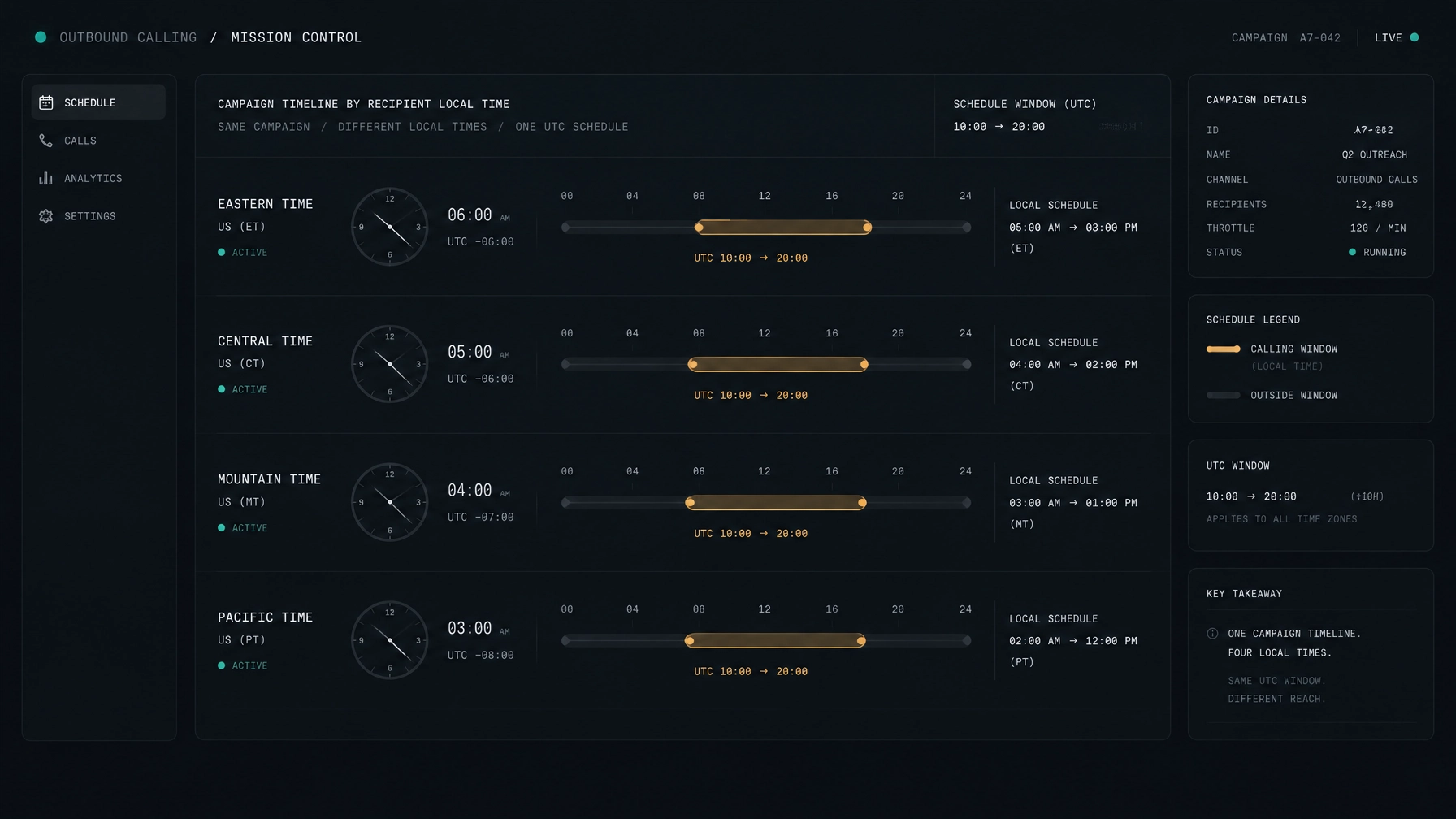
A calling schedule can look reasonable at headquarters and still place calls outside the permitted window for the people you’re trying to reach. That is the risk behind calling hours time zone compliance: the clock that matters may be the recipient’s local time, not the call center’s.
For contact center compliance leads and BPO operations managers, a single national campaign can span multiple clocks, state rules, and call types. A dialer can help your team manage when calls are placed. It cannot decide every legal question or make a campaign compliant by itself. Your business remains responsible for the campaign.
Start with the local clock
Under the federal Telephone Consumer Protection Act (TCPA) and the FCC’s implementing rules, the general federal restriction on telephone solicitations to residential subscribers is in 47 C.F.R. § 64.1200(c)(1). It prohibits these solicitations before 8 a.m. or after 9 p.m., measured by “local time at the called party’s location.”
That phrase matters. If your agents work in one time zone and call people in several others, headquarters time is not a reliable stand-in for the recipient’s clock. A campaign scheduled to start at a convenient hour for your team could reach someone too early in their local time.
The federal rule is a baseline for the specific calls it covers, not a universal safe harbor for every outbound call. State requirements may be stricter, and other rules can apply based on the number called, call purpose, consent, and technology used. Review the current FCC regulation and FCC consumer guidance as part of your compliance review.
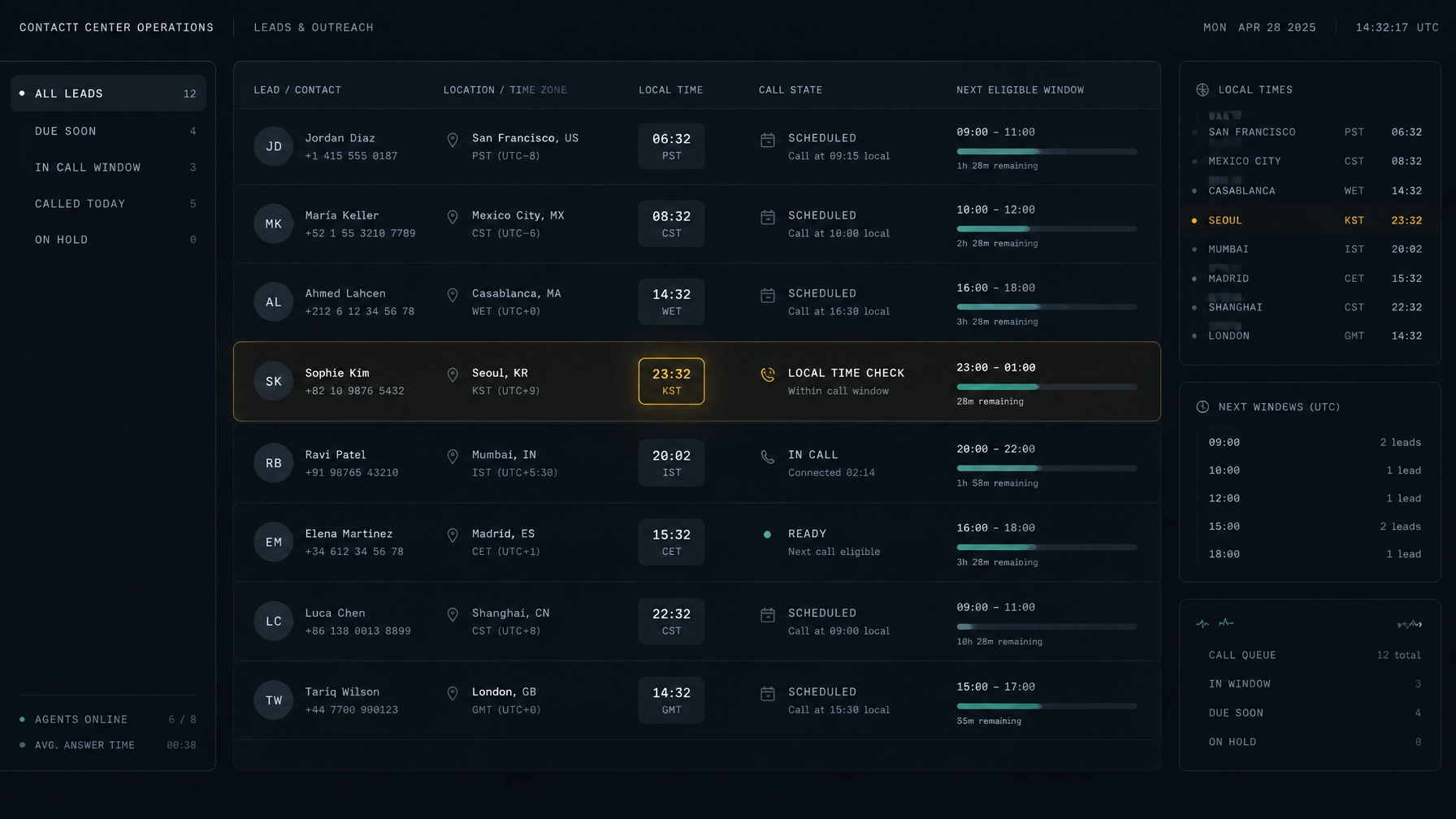
Why “local time” changes your schedule
“Local time” means the applicable local time at the called party’s location. It does not mean the agent’s time, the contact center’s time, or the time zone attached to the campaign creator’s account.
That difference becomes easy to miss when a team uses one schedule for a list spread across the country. A campaign open at 8 a.m. in one region may be earlier in another. The issue can also surface when an operation spans more than one time zone within a state.
Phone numbers alone may not establish where a person currently lives or works. A number’s area code can be a clue, but people move and keep their numbers. When location information is incomplete or uncertain, don’t treat an assumed time zone as verified. Decide how your business will resolve uncertain records before those records enter a live campaign.
Daylight saving time adds another operational check. Local clock changes do not happen everywhere at the same time, and some locations do not observe them. A fixed offset from headquarters can therefore drift from the recipient’s local clock. Use current, location-aware time-zone information and review how your systems handle clock changes.
Common misreads to catch early
A schedule can fail even when the campaign settings look tidy. Check for these common assumptions:
- One time zone is the master. A single headquarters schedule does not account for every recipient’s local time.
- An area code confirms location. It may not reflect where the person currently resides or works.
- Daylight saving changes are uniform. Locations may observe different rules or change clocks on different dates.
- Federal hours cover every campaign. The federal residential-solicitation restriction is not a summary of every state or federal rule.
- All automated calling is treated the same. TCPA and FCC rules distinguish among call methods, call purposes, and the numbers contacted. A predictive dialer, an autodialer under the legal definition, and an artificial or prerecorded voice are not interchangeable labels.
- A permitted hour means the call is permitted. Hours are only one part of the review. Consent, do-not-call obligations, caller identification, and other requirements may also matter.
For example, the TCPA and FCC rules contain separate restrictions involving certain calls using an automatic telephone dialing system or an artificial or prerecorded voice. The applicable requirements depend on the call and the number being called. Do not assume that a call is covered, or exempt, based only on the name of the dialing mode. Have counsel assess the specific technology and campaign.
State laws can narrow the available window or add conditions. Florida’s 2026 statute on unlawful telemarketing acts, for example, bars covered commercial telephone solicitation calls before 8 a.m. or after 8 p.m. in the called person’s time zone. It also addresses calls made through automated dialing or recorded messages. Its scope depends on the statute’s definitions and circumstances, so use it as a reminder to check state law, not as a complete guide to every campaign.
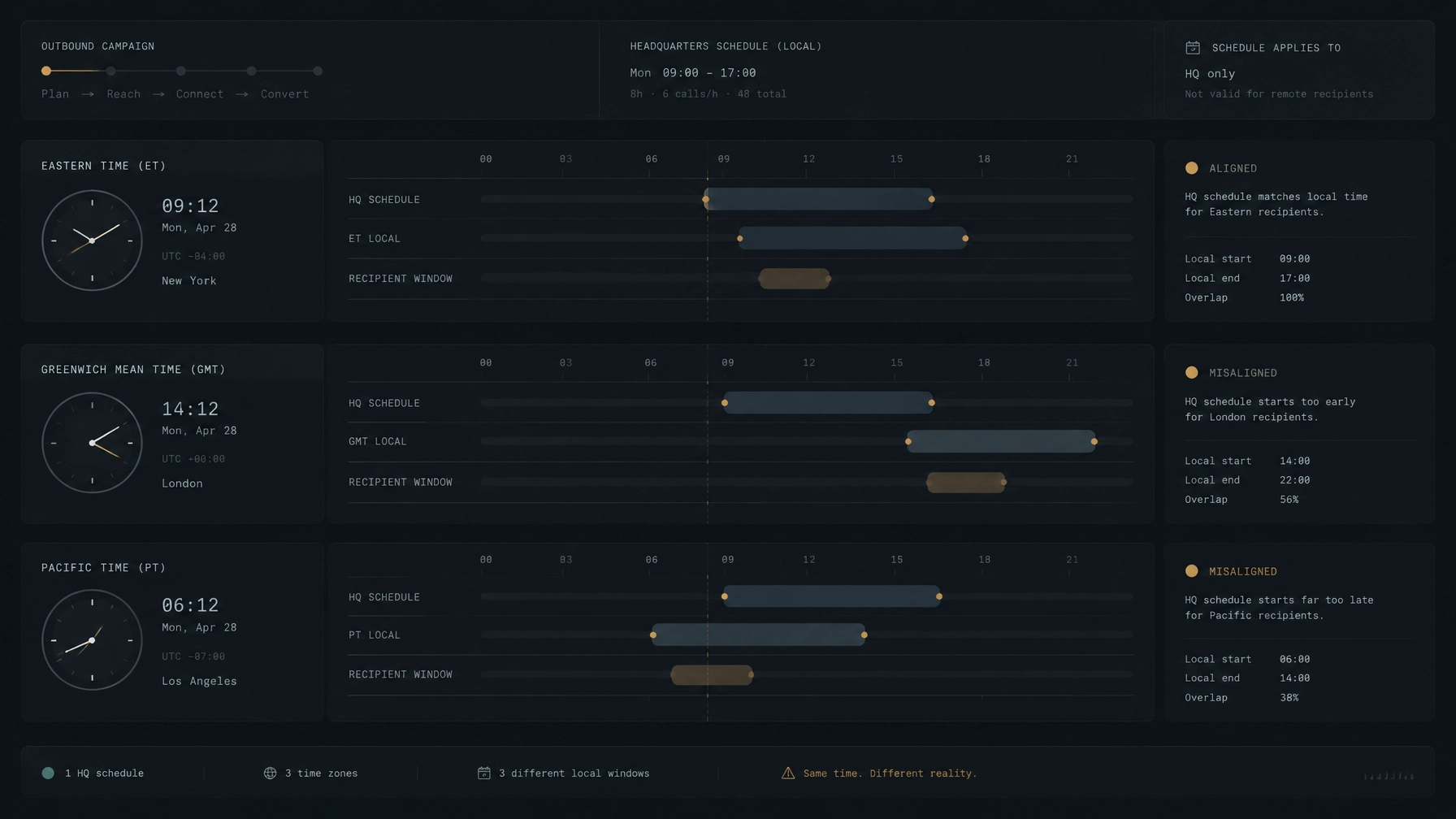
Build a schedule around the recipient
A practical outbound calling compliance process starts before agents begin dialing. Use these steps to make the schedule easier to review and maintain.
1. Map records to a location
Keep the location data your team needs to identify the recipient’s applicable local time. Review how the data is collected and updated. Flag missing or conflicting information rather than silently assigning a time zone based on an unverified assumption.
2. Set the permitted window
Identify the federal and state rules that apply to your campaign and audience. Where state or local requirements are more restrictive, configure operations around the applicable limit. Consider an internal buffer near the edges of a calling window to reduce risk from inaccurate location data, time-zone conversion errors, or delayed calls.
3. Test the campaign from different clocks
Before launch, test representative records from each relevant time zone and state. Confirm the schedule behaves as intended around local opening and closing times, weekends, holidays, and daylight saving transitions where relevant. Repeat those checks after list changes or campaign edits.
4. Record the decision
Document which rules and time-zone assumptions informed the schedule, who reviewed it, when the review took place, and what changed. Keep a clear process for handling records with uncertain locations, and make sure agents know how to pause or escalate a questionable contact.
5. Review the full call context
Calling hours are not the only control. Check call purpose, recipient type, consent status, do-not-call screening, opt-out handling, and the technology used. Revisit your review when a campaign changes, a new state is added, or a relevant rule is updated. Consult qualified legal counsel about how current federal and state requirements apply to your business.
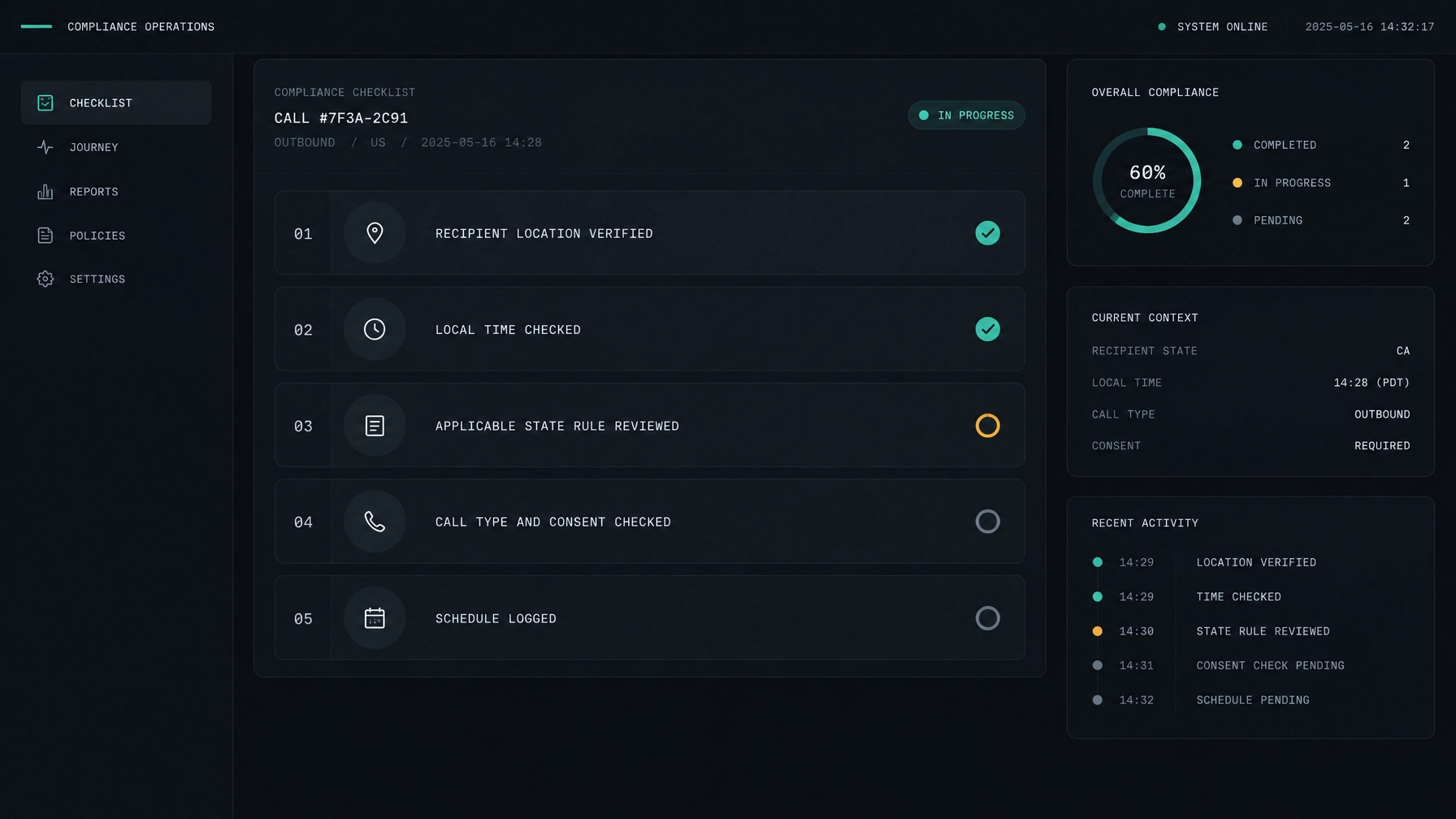
Use a dialer as an operational control
Contact centers use dialing software to manage outbound workflows and when calls are placed. Depending on the platform and configuration, a dialer may help teams apply campaign rules consistently and reduce reliance on manual decisions. But software settings reflect the rules and data your business provides. A time-zone setting cannot resolve an unclear recipient location, determine which state law applies, or establish that a particular call has valid consent.
NexusDialer’s website describes campaign calling workflows, progressive and predictive dialing, and contact-list imports. The public product information reviewed for this article does not confirm a specific calling-hours scheduling feature, so this article does not claim that NexusDialer provides one. Confirm the current capabilities and setup requirements with the team before relying on any platform for a compliance control.
If you are reviewing outbound operations more broadly, you may also find How to Reduce Contact Center Costs Without Switching SIP Providers useful when assessing how calling tools fit into your setup.
A dialer can support an operational process. It does not transfer or remove your compliance responsibility. The business remains responsible for the campaign, its data, its settings, and its legal review.
Frequently asked questions
What are the legal calling hours?
For covered federal telephone solicitations to residential subscribers, the FCC rule generally prohibits calls before 8 a.m. or after 9 p.m. in the called party’s local time. State rules may impose narrower hours, and other requirements may apply depending on the call. Verify the rules that fit your campaign.
Do calling-hour rules differ by state?
Yes. States can impose requirements that differ from or add to the federal baseline. Florida’s 2026 statute, for example, sets an 8 a.m. to 8 p.m. local-time limit for covered commercial telephone solicitation calls. Check the current law in each relevant state and ask counsel to assess its scope.
Does local time mean the call center’s time?
No. The federal rule for covered residential solicitations refers to local time at the called party’s location. A headquarters schedule can be useful for staffing, but it does not replace recipient-local time checks.
Do autodialed and prerecorded calls follow the same rules?
Not necessarily. TCPA and FCC requirements can differ by call type, technology, recipient, and purpose. The legal meaning of an autodialer may also differ from everyday use of the term. Review the actual campaign and technology with qualified counsel.
Does a dialer make an outbound campaign compliant?
No. A dialer may help manage calling operations, but it cannot by itself verify every relevant fact or satisfy every legal requirement. Compliance responsibility stays with the business.
This article provides general information, not legal advice. Laws and rules can change, and their application depends on the facts of a campaign. Verify current FCC and TCPA requirements, state regulations, and other applicable obligations with qualified legal counsel.