Billing Clients for Talk Time, Not Dials: A Guide for BPOs
Your client wants to know what their campaign delivered. Your dialer report shows how many times your team tried to reach someone. That gap can make a busy operation look productive without showing the conversations behind the work. It can also leave clients unsure what they are paying for. A clearer BPO outbound talk time…
Your client wants to know what their campaign delivered. Your dialer report shows how many times your team tried to reach someone.
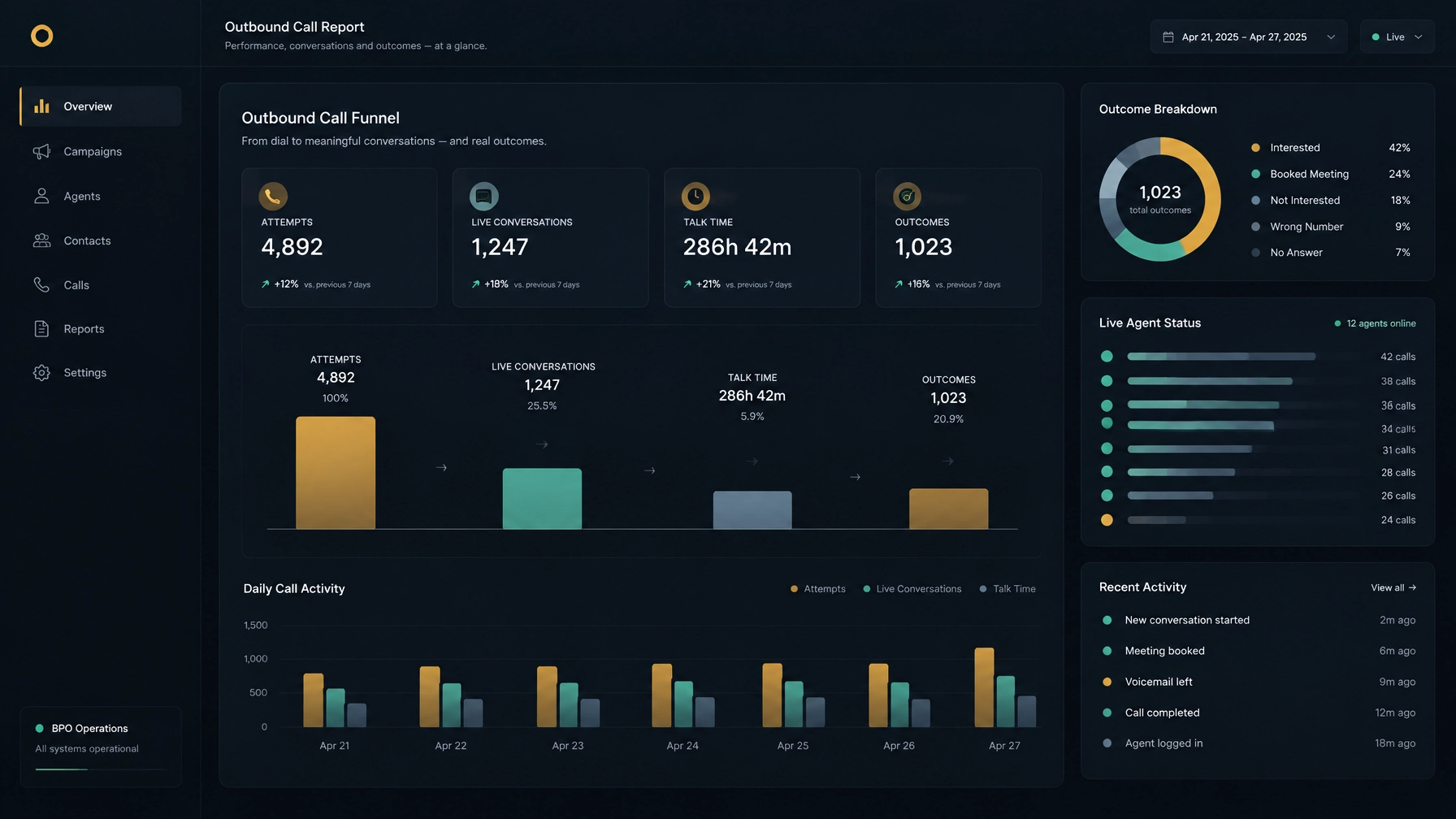
That gap can make a busy operation look productive without showing the conversations behind the work. It can also leave clients unsure what they are paying for. A clearer BPO outbound talk time report connects attempts to live conversations, agent time, and agreed outcomes.
Talk-time reporting does not suit every contract. Some clients pay per attempt, connection, hour, or completed outcome. Before you change how you invoice, agree on the billing basis and metric definitions with the client. Then build a report that makes the work easy to understand and reconcile.
Why dial counts create friction
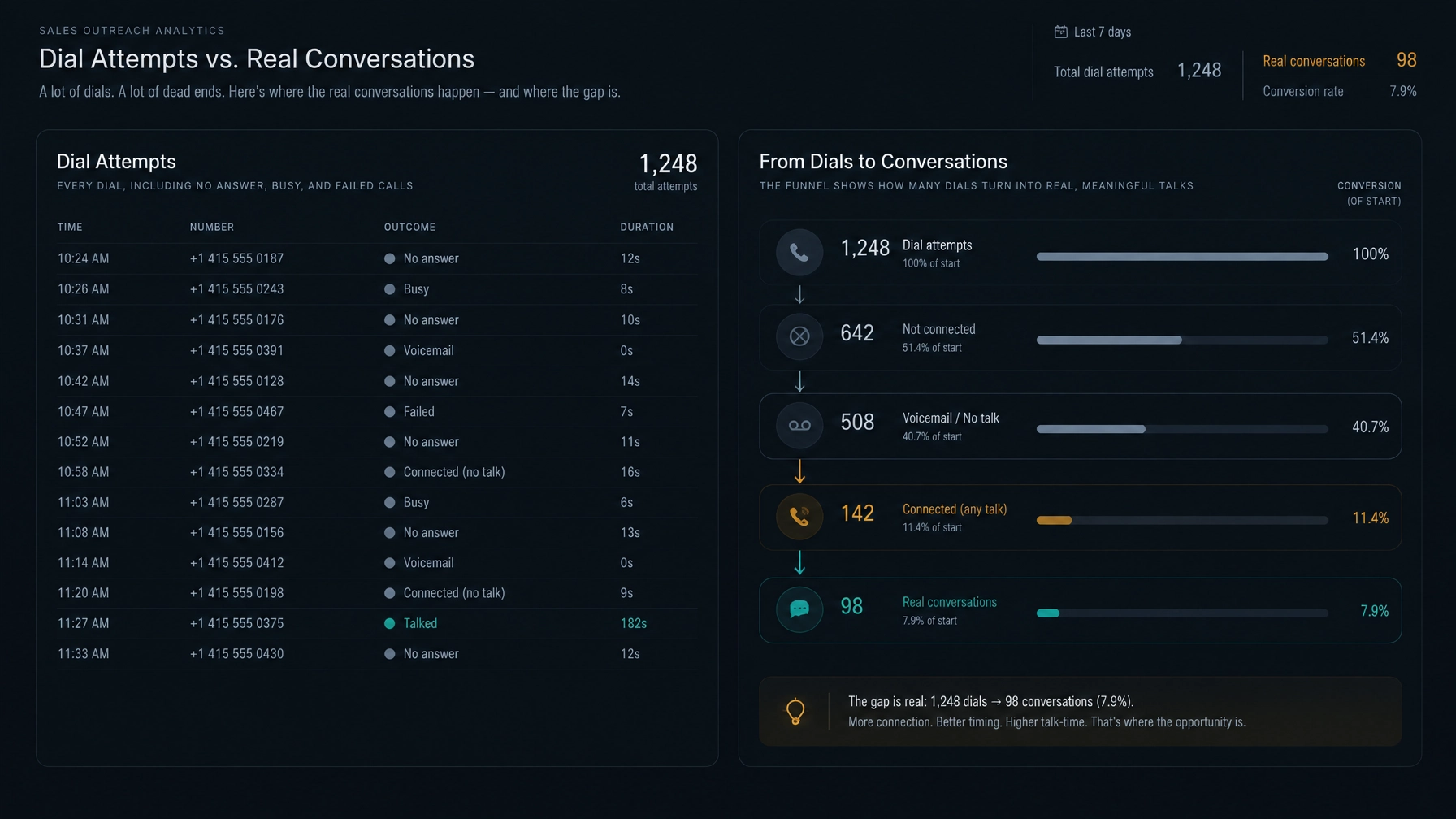
A dial is an attempt to make contact. It is not proof that a person answered, that an agent spoke with them, or that the call achieved its purpose.
When a report leads with dial volume, clients may see activity but struggle to judge its value. They may ask whether unanswered calls, voicemail, or repeat attempts count toward delivery. If the invoice uses one definition of “connection” and the report uses another, reconciliation gets harder.
The problem is not that attempt counts are useless. They help explain campaign activity and diagnose contact rates. The problem is treating attempts as a complete account of work.
A better report shows the journey from attempt to conversation to outcome. It gives the client enough detail to see what happened and compare the result with the contract.
What a talk-time report should include
Keep the client scorecard focused. Include enough context to explain the invoice, without burying useful information in a long list of disconnected numbers.
1. Attempts and connections
Show the number of outbound attempts alongside the number of connected calls. State what “connected” means in your report. A platform may register a network answer that turns out to be voicemail or an automated system. Don’t label every network answer a live conversation unless that matches your definition.
2. Eligible conversations and agent talk time
Count the conversations that meet the client’s agreed criteria, then show the talk time associated with those conversations. If you bill by talk time, make the billed minutes traceable to call-level records and explain any rounding rules.
3. Outcomes per conversation
Report how conversations ended using a shared set of dispositions. Depending on the campaign, these may include a qualified contact, appointment, callback, refusal, wrong number, or another agreed result.
Outcomes help clients understand what the time produced. They also make it easier to spot a campaign where the team is speaking with people but not moving them to the next step.
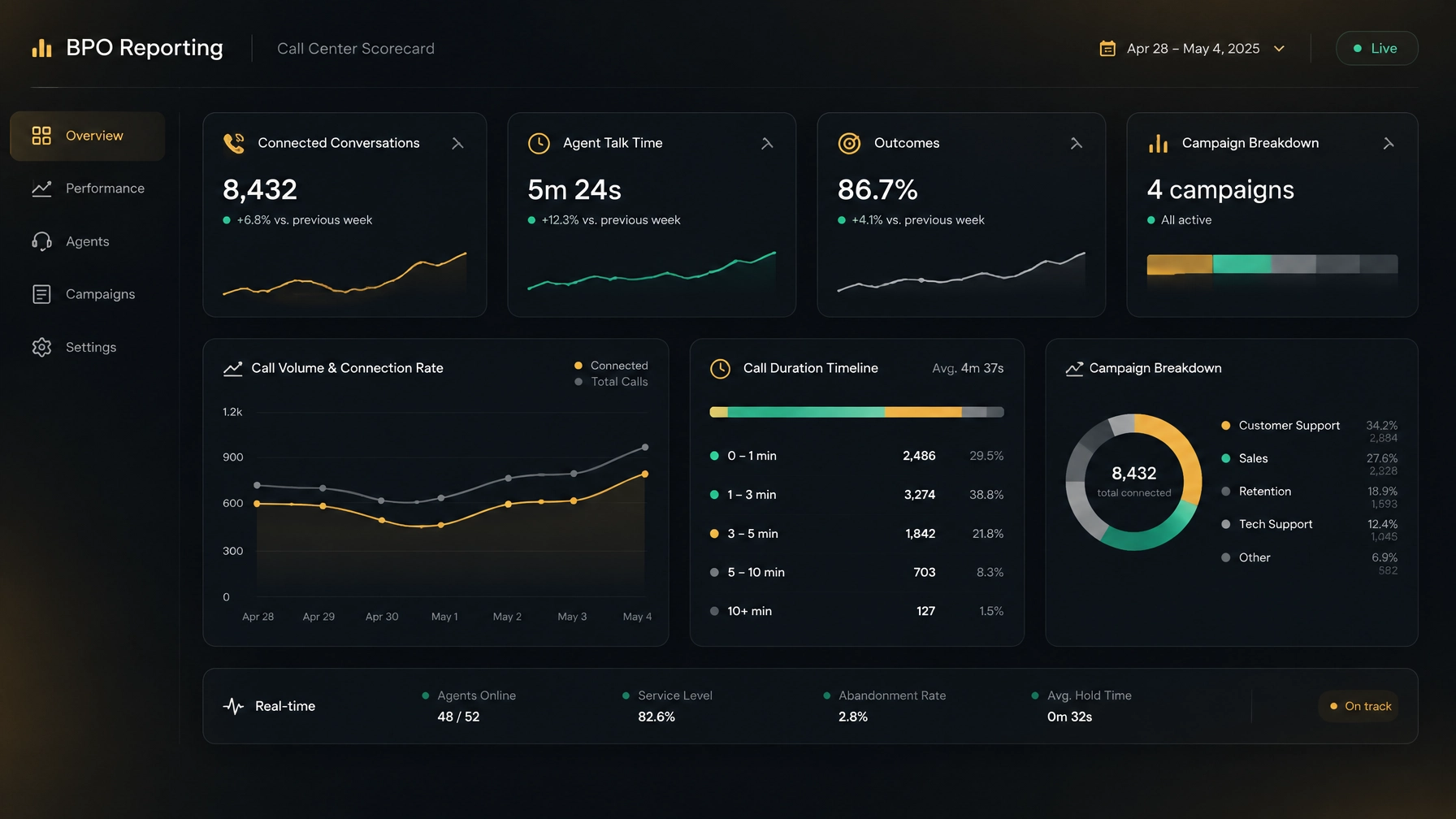
4. Campaign and client breakdowns
Separate results by client and campaign. If the work spans multiple lists, markets, or teams, break those out where the client needs that view. Keep the categories consistent from one report to the next so comparisons remain meaningful.
Build the report from call data
Step 1: Define a billable conversation
Write down the conditions that make a conversation eligible for billing. For example, you might require that an agent spoke with a live person, the call belongs to the correct campaign, and the record has a valid disposition.
Then agree on edge cases. Do voicemail, interactive voice response (IVR), transfers, callbacks, and calls with a failed or missing record count? There is no universal definition that fits every BPO contract. Put the agreed definition in the statement of work and use it in both reporting and invoicing.
Step 2: Separate talk time from handle time
Talk time measures the time an agent spends speaking with the other party. Handle time is broader. It can include talk, hold, and after-call work, such as logging an outcome or scheduling a follow-up.
Don’t use total call duration as a substitute for talk time unless you have confirmed what that duration includes. Report talk and handle time separately if the client needs to understand both conversation and agent workload.
Step 3: Segment by client and campaign
Add fields that let you group records by the right account, campaign, and reporting period. You may also need to separate attempts from unique contacts: one contact called three times is three attempts, but still one contact.
Use the same grouping rules throughout the report. If a record moves campaigns, decide which campaign receives the attempt, conversation, and outcome, and document that rule.
Step 4: Reconcile the metrics
Check totals across the dialer, call records, agent activity, and invoice before sending the report. Investigate mismatches instead of silently excluding them.
A useful scorecard can define each metric in a short glossary:
- Attempts: outbound calls placed during the period.
- Connected calls: calls meeting the agreed connection definition.
- Eligible conversations: connected calls that meet the client’s billable-conversation rules.
- Talk minutes: eligible agent talk time, using the agreed rounding method.
- Outcome rate: calls with a specified outcome divided by the agreed base, such as eligible conversations.
For additional guidance on outbound call volumes and durations, see Talkdesk’s outbound contacts data dictionary.
Step 5: Explain what the numbers mean
A report should help the client decide what to do next. Don’t leave them to interpret a change in talk time or outcomes on their own.
For example, more talk time with fewer qualified outcomes may call for a review of list quality, messaging, or qualification criteria. Fewer conversations may reflect a change in contact availability or a campaign schedule. Note the observation, what you checked, and any action you recommend. Be clear about what the data shows and what still needs investigation.
Use a cadence that fits the decision
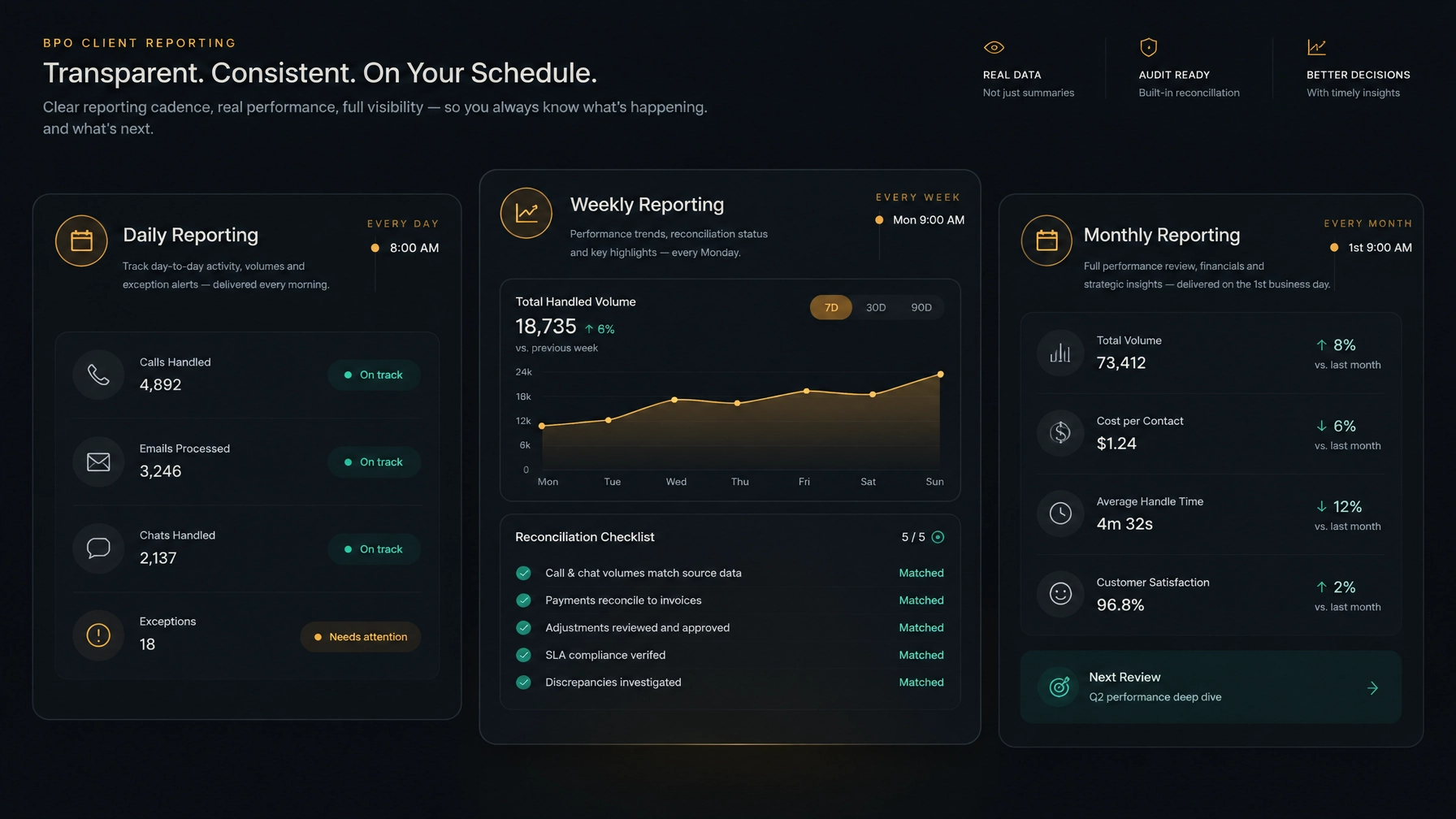
A single monthly invoice report may be too late for operations teams to correct a campaign issue. A real-time view may be too detailed for a client review. Match the reporting cadence to the decision.
- Daily: Share activity, conversations, outcomes, and exceptions for operational follow-up.
- Weekly: Review trends by campaign, team, and agreed outcome. Note changes and actions.
- Monthly: Reconcile billable minutes and outcomes with the invoice. Resolve exceptions and review contract measures.
Keep the same metric definitions across each view. If a number changes because you corrected a record or applied a new rule, say so. Transparent reporting helps prevent avoidable billing disputes and gives the client a consistent basis for reviewing performance.
A client review in practice
Imagine a BPO account manager preparing a weekly review for an outbound appointment-setting campaign. The client’s contract bills eligible agent talk time and separately tracks agreed appointments.
The manager starts with attempts and live conversations, then explains which calls qualified for billing. The report shows talk minutes, outcomes, and a campaign breakdown. It separates voicemail and unanswered calls from conversations, as set out in the contract. The account manager then points out that one list segment produced fewer appointments and proposes reviewing its contact data before the next reporting period.
The client can see what was attempted, what connected, what time is billable, and what the team achieved. If the client questions a billed call, the account manager can review the relevant record and apply the agreed definition. The report makes the conversation about shared rules and evidence, rather than competing totals.
Make conversation-level visibility part of the workflow
Reports are only as reliable as the records behind them. Capture outcomes consistently, keep call records tied to the right client and campaign, and make exceptions easy to review.
NexusDialer’s public site describes call records with saved outcomes, notes, and callbacks, as well as views for managers to review team activity. Those records can support conversation-level review. Confirm whether a platform meets your client reporting, reconciliation, and billing requirements before relying on it for those tasks.
If you’re comparing workflows, read how BPOs and contact centers can reduce costs without switching SIP providers. You can also explore NexusDialer and ask the team about evaluating it for your BPO setup. Confirm account approval, telephony setup, and any trial terms directly.
Frequently asked questions
What metrics should BPOs report to clients?
At minimum, report attempts, connected calls, eligible conversations, agent talk time, and agreed outcomes. Include the definitions and billing rules behind each metric. Add campaign or client breakdowns when they help explain performance or reconcile charges.
What is talk time in a call center?
Talk time is the time an agent spends speaking with the other party. It is different from handle time, which may also include hold time and after-call work. Confirm how your systems measure these values before using them for billing.
Are connected calls the same as live conversations?
Not necessarily. “Connected” may refer to a network connection, which can include voicemail or automated systems depending on how the data is recorded. Define whether your report counts a human conversation, a verified right-party contact, or another event.
Should a BPO bill by talk time or by outcome?
That depends on the contract and the client’s goals. Talk-time billing can make agent conversation visible, while outcome-based billing ties payment to agreed results. Some contracts use a combination. Set the definitions, exclusions, and reconciliation process before work begins.
How often should BPOs send client reports?
Use a cadence that supports the client’s decisions. Daily updates can help with operational issues, weekly reviews can surface campaign trends, and monthly reports can support invoice reconciliation. Keep metric definitions consistent across all three.